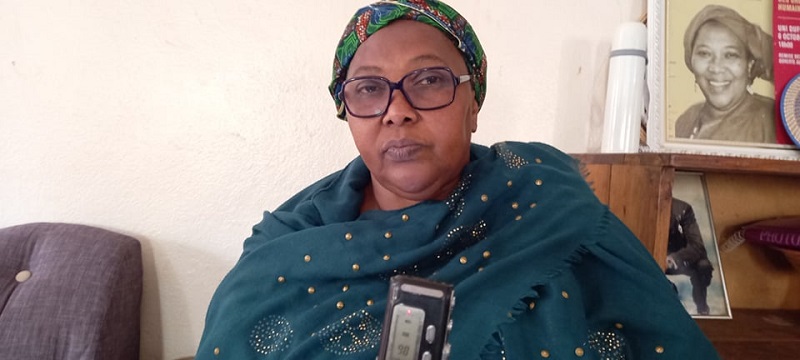
Winner of the “Solidarity Award” at the first edition of Mousso Sigui, the annual gathering of Women Human Rights Defenders (WHRDs) from West Africa held on July 30 and 31, 2026, in Abidjan (Côte d’Ivoire), Ms. Diallo Asmaou, president of the Association of Victims, Relatives, and Friends of September 28, 2009 (AVIPA) in Guinea, reflects on the significance of this award. She shares her experience, the challenges faced by women human rights defenders, and the importance of building a supportive and sustainable network to strengthen the resilience of women committed to defending human dignity.
Question 1. Ms. Diallo Asmaou, you are the winner of thefirst Solidarity Award. What does this award mean to you? And what does it mean for all the women who defend human rights in your region?
Receiving the Solidarity Award at the first edition of “Mousso Sigui” is a tremendous honor for me, but above all, a great responsibility. I believe this award goes far beyond me personally. It honors all the survivors who have found the courage to turn their suffering into strength, as well as all the women human rights defenders who, every day, work in sometimes very difficult circumstances to defend human dignity.
This award is also a message of hope. It serves as a reminder that the work of women human rights defenders is recognized and deserves our support. In our region, where challenges abound, this recognition encourages us to continue our commitment with even greater determination. It also reminds us that we are not alone: solidarity among women is one of our greatest strengths.
Question 2. Can you recall a specific act of solidarity among women that really left an impression on you throughout your life?
Yes, there were several moments that left a deep impression on me. But the one that moves me the most is the solidarity I saw among the survivors of the events of September 28, 2009.
Although each of them carried her own wounds, they chose to support one another, to stand by those who were afraid to speak out, to share their experiences, and to rebuild their dignity together. This solidarity was crucial to our fight for justice.
I was also deeply moved by the efforts of many women human rights defenders—in Guinea as well as in other West African countries—who stood by us, supported us, and amplified our voices on the national, regional, and international stages. Their commitment taught me that no struggle can be won alone.
Question 3. In your opinion, what are the biggest challenges facing women who defend human rights in West Africa today, and how can they become stronger together?
Women human rights defenders face many challenges: threats, intimidation, smear campaigns, gender-based violence, a lack of resources, restrictions on civic space, and, at times, the absence of adequate protection mechanisms.
Added to these challenges are often family responsibilities and social stereotypes that make their commitment even more demanding. I am convinced that our strength lies in solidarity. We must strengthen our networks, share our experiences, develop early warning and protection mechanisms, build our capacity, and speak with one voice when any one of us is threatened.
When we support one another, we are much stronger and much more resilient.
Question 4. How do you think “Mousso Sigui” will help create a strong and sustainable network among women human rights defenders in the region?
I believe that “Mousso Sigui” is an extremely important initiative because it creates a genuine space for women human rights defenders in West Africa to come together, engage in dialogue, and gain recognition.
Beyond simply presenting an award, this initiative promotes the exchange of experiences, the sharing of best practices, networking, and solidarity among women who are active in different contexts but often face similar challenges.
I hope this momentum will continue over time through joint initiatives, training, mutual support mechanisms, and regional advocacy for better protection of women human rights defenders.
Building a sustainable network also means building a collective voice capable of influencing public policy and promoting a culture of human rights throughout our region.
Question 5. What advice would you give to young women who want to defend human rights, even though they know it will be difficult because of social, political, or security issues?
I'd like to tell them never to underestimate the value of their voice.
The journey won't always be easy. There will be moments of doubt, obstacles, and sometimes even risks.
But every advance in human rights is the result of the courage of women and men who refused to give up.
I encourage them to pursue training, to work with integrity, to join credible organizations, to build networks of solidarity, and to take care of themselves, because standing up for others also means safeguarding one’s own safety and well-being.
Finally, I would like to remind them that they are not alone. Other women have paved the way before them, and today we have a responsibility to reach out to them so that they, in turn, can become agents of change.
I firmly believe that every woman who dares to defend human rights helps build a more just, more inclusive, and more humane society for future generations.
Thank you very much

