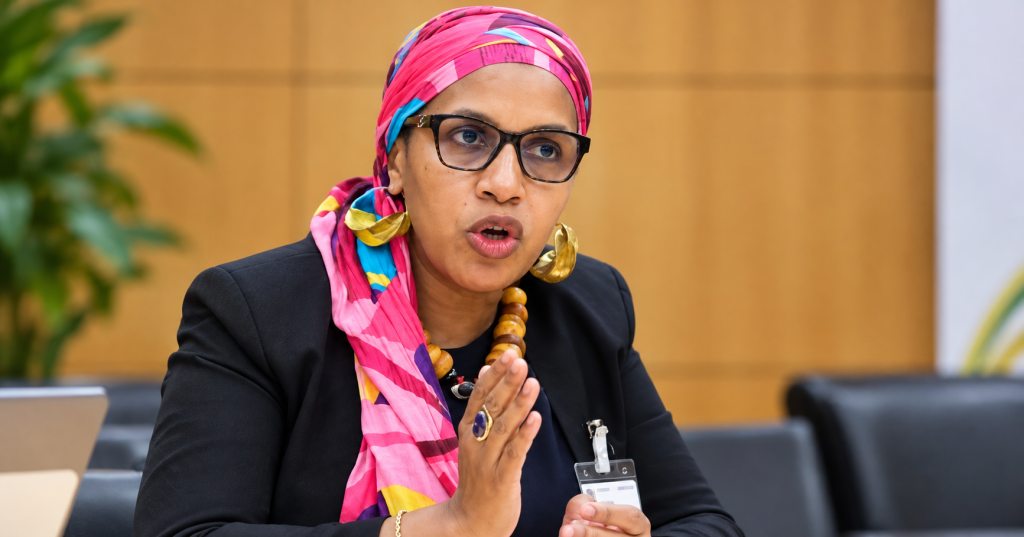
Against a backdrop of pressure, threats, and violence, Binta Sidibé-Gascon, president of the KISAL Observatory, shares her journey as a human rights defender. Balancing personal pain with collective commitment, she explains how resilience becomes a vital source of strength for women in West Africa, transforming fear into determination and isolation into solidarity.
1. Could you tell us about the greatest challenges you’ve faced as a human rights advocate and how you’ve turned them into a strength?
In the Sahel region, defending human rights exposes individuals to intense pressure, threats, and reprisals—either against themselves or their loved ones when they cannot be targeted directly. We are helplessly witnessing a shrinking civic space and numerous rights violations affecting civil society organizations as well as anyone who dares to speak out about the national situation in the countries of the Central Sahel.
In the face of all these challenges, we are determined to stand strong and move forward so that we can help and give a voice to the voiceless.
There is this vast, unseen part of us—the pain, the fear, the anxiety, and sometimes the discouragement—because we feel so powerless in the face of certain situations, especially when we fail or don’t get the results we want.
Among these major challenges are sometimes having to face threats, pressure, discrimination, stigmatization, criticism, insults, discouragement, a lack of resources (logistical, financial, human, etc.) to respond to every request or plea for help, misunderstandings, and that feeling of being alone when facing certain situations. These are the hardest moments, when I sometimes find myself alone, filled with questions: Should I continue or stop? I’ve wondered if the price I’m paying for my commitment isn’t too high—especially when my loved ones and my family are put at risk because of my commitment.
Beyond the narrative and advocacy we champion—which we’re able to share more easily with many people—we must also find ways to share our questions, our concerns, and our fears. This often-hidden side of ourselves must be shared with the people of our choosing: colleagues, friends, family, and others. We must also not hesitate to seek help from professionals—above all, we must not remain alone and isolated. For my part, I encourage everyone, especially during these times of great difficulty, to reach out to specialists; it is essential if we want to continue helping others. We must be willing to accept help ourselves when the need arises.
My family has been directly targeted on several occasions; unfortunately, some have lost their lives. It is these loved ones—whose stories, daily lives, and journeys I know well, right up to their tragic ends in the face of this injustice—who, along with all the other victims, are at the heart of my resilience. Their courage and dignity—even in the face of their extrajudicial executions—are my greatest sources of courage and my determination to reject injustice. My greatest strength today is transforming what I have experienced into yet another reason to keep going. The victims, survivors, and their families who have shared their stories with us are waiting for justice; our commitment to stand by them is essential.
2. In your opinion, why is resilience so important for women who defend human rights in West Africa?
Resilience is crucial for women who defend human rights in West Africa, as the situation on the ground—marked by a severe erosion of civic space and security concerns in certain areas—leaves them more vulnerable. They are well aware of the situation because they are the primary victims of this crisis. Furthermore, they face personal, familial, social, economic, and sometimes security-related pressures. They must confront numerous challenges, including threats, intimidation, social pressures, and a lack of financial resources, as well as a cultural context in which some people believe that a woman should not take such risks to defend her convictions.
This resilience is essential for women who defend human rights in West Africa, enabling them to assist other vulnerable women—who will find it easier to reach out to them than to men. This resilience becomes a collective feminine resilience that breaks the cycle of isolation, thereby creating a chain of solidarity, making them stronger and enabling women defenders to stand firm, confront intimidation and threats without abandoning their convictions, while resisting discrimination based on their gender—particularly in environments where women’s voices and leadership may be challenged.
3. Can you recall a time when your commitment was truly put to the test, but you still managed to find the energy to keep going?
My commitment was put to the test when several members of my family were victims of extrajudicial killings. With the rise of terrorism and the fight against terrorism, we have intensified our advocacy to ensure that respect for human rights and the protection of civilians take precedence over all other priorities during on-the-ground operations in the Sahel. Unfortunately, civilians have paid a heavy price and continue to do so in the Central Sahel. For years, we have raised our voices and advocated to prevent this situation, but conditions on the ground continue to deteriorate sharply, leaving us feeling powerless—and at times, a sense of failure—as the list of unarmed civilian victims grows, and we ourselves have become families of victims and survivors.
I found the strength to keep going through the support and encouragement of my family, friends, colleagues, partners, and many others, but also through my thirst for justice in the face of all these crimes, the heartfelt cries and late-night phone calls from mothers in the remote corners of the Sahel asking for help—because I am their only hope for making their plight heard. We have no right to abandon them and turn a deaf ear to their cries, despite the difficulties and adversity.
4. How can this recognition of your resilience motivate and help other women to continue their work defending human rights, even when it’s difficult?
Society forces us to put on a facade that “everything is fine,” and we don’t dare talk about that sometimes invisible, painful side—our fears, anxieties, and bouts of depression—for fear of being stigmatized as having a mental illness, even though it is precisely this invisible side that reminds us that we are human.
There are times when we doubt ourselves, when we’re afraid, when we wonder if we should keep going. I’ve experienced those moments, especially when the challenges of my commitment affected my family. It was during those times that I realized resilience doesn’t mean being strong all the time. It means finding, despite the fear and pain, a reason to keep going.
For me, this award is much more than just personal recognition. It is a source of encouragement for all women who, despite the difficulties, continue to defend human rights.
I hope it reminds them of one essential thing: what they’re doing is very important; even when they feel discouraged or like they’re fighting alone, their actions matter immensely, and the change we all want cannot happen without them—they are and will remain key players in bringing about real change.
If this award can give strength to another woman, then it will have deep meaning for me. I hope that a young advocate going through a difficult time might say to herself, “Binta also faced challenges; she had her doubts, but she kept going. So I, too, can keep going.”
I also want to show that we don’t have to be strong on our own. Solidarity among women, support from families, colleagues, and human rights networks are essential.
Our resilience grows stronger when we build it together.
I therefore view this award as a responsibility. It encourages me to share my experience, support other women, and help create an environment in which they can continue their work with greater security, confidence, and solidarity.
If my award can turn a woman’s discouragement into courage, her doubt into confidence, and her fear into determination, then this recognition will have truly fulfilled its purpose.
5. What resources or joint initiatives could be improved to help women human rights defenders remain resilient in the face of dangers and pressures in the region?
Given the current situation, there is an urgent need to identify and establish channels of communication with all these women to share our experiences in order to prevent risks, issue rapid alerts, provide protection for the women human rights defenders and their families, and offer financial, legal, and psychological assistance—all through the establishment of a regional early warning mechanism for women human rights defenders. This mechanism will be able to assess the risk and, subsequently, mobilize the relevant actors and trigger an appropriate response.
Before implementing this mechanism, it would be a good idea to start by taking stock of what already exists and what needs to be improved.
It is also necessary to map women human rights defenders by country; this will help break the isolation experienced by some and foster local—and subsequently regional—solidarity. These women human rights defenders, who will be identified by country, will serve as country focal points and as points of protection for women human rights defenders; drawing on their experiences, they will be able to provide advice, guidance, and prevention efforts. This local solidarity among women human rights defenders will complement solidarity at the regional level, and it is this chain of solidarity that will transform our vulnerabilities into collective strength to bring about change in the region and enable us to get to know one another better and support one another. It will also enable us to establish a regional system for documenting and monitoring attacks against women human rights defenders in order to strengthen our collective advocacy with states and regional institutions, backed by concrete facts.

